
Colorado Septic Systems in 2027: Permits, Pricing, Perc Testing, Soil Testing, Costs & Regulations

Updated: Oct 17

Your Complete 2027 Guide to Colorado Septic Permits, Soil Evaluations, OWTS Requirements, and Septic System Planning
Planning to build a home in Colorado in 2027? Buying vacant land? Replacing an old septic system? Before you begin construction, understanding Colorado's septic system regulations, soil conditions, and local permitting requirements can save time, money, and costly construction delays.
Land Systems West LLC helps Colorado property owners navigate septic system planning, soil testing, perc testing, excavation, and land development. Whether you're building along the Front Range or developing challenging mountain acreage, understanding your property's wastewater options is an essential first step.
This guide answers the most common questions about Colorado septic permits, perc tests, soil evaluations, engineered septic systems, installation costs, and county requirements for 2027.
Need help with your property? Contact Land Systems West at 720-806-0559 or visit www.soiltestandseptic.com.
1. Do You Need a Septic Permit in Colorado in 2027?
In most cases, a new onsite wastewater treatment system requires approval from the appropriate local permitting authority before construction.
Colorado commonly calls septic systems On-Site Wastewater Treatment Systems (OWTS). Depending on the property and project, permitting requirements may also apply to system replacements, repairs, expansions, and modifications.
A typical application may require:
A completed septic permit application.
Soil evaluation results and test pit documentation.
Percolation test results when applicable.
A site plan identifying the proposed system and relevant property features.
A septic system design and engineering documents when required.
Applicable fees and supporting information.
Colorado Regulation 43 establishes statewide OWTS requirements, while local public health agencies administer permitting and may have additional applicable requirements.
Official resource: Colorado Regulation 43 — On-Site Wastewater Treatment System Regulations.
Important for 2027: Verify the current requirements with the agency responsible for your property. Never assume that an existing septic approval authorizes a larger home, additional bedrooms, or a different system configuration.
Biggest Changes in the Colorado Reg 43 update from 2026 is more cost added by the state engineers. They require lager basal footprint than neccessary. This adds uneccessary costs at install time and there is no way any contractor can avoid it. The regs are actually so messed up they give you a level 3 rating after the sand filter which designates an undergound trapezoid of sand to install. Extra sand is extra money.
2. What Is a Perc Test in Colorado?
A percolation test, is actually a soil test now. 2 pits 8 ft deep but commonly called a perc test, evaluates how water moves through soil under a prescribed testing procedure.
Perc testing can help inform septic system planning, but it is not the only factor used to determine whether land is suitable for a septic system.
Depending on the project and applicable requirements, a site and soil evaluation may also examine:
Soil texture and structure.
Soil horizons and restrictive layers.
Depth to bedrock.
Seasonal groundwater conditions.
Slope and drainage.
Available area for the soil treatment system.
Required setbacks from wells, property boundaries, water features, and other regulated features.
A favorable perc test does not guarantee septic approval. The entire site must meet the applicable requirements.
Is a perc test required for every Colorado property?
Not necessarily in the same form. The required investigation depends on the applicable regulations, site conditions, proposed system, and local permitting requirements. A soil evaluation may involve test pits, soil classification, field observations, and percolation testing where required.
Before scheduling testing, confirm what the local agency needs and how the results must be documented.
A Perc test is now a soil test with up to (3) 8ft deep pits for the county to concur on soil types.

3. What Is Septic Soil Testing, and Why Is It Important?
Septic soil testing helps determine whether a property's soil and site conditions can support a compliant onsite wastewater treatment system.
The investigation is especially important when purchasing vacant land or planning construction in areas where soil depth, groundwater, bedrock, and slopes vary significantly.
A typical evaluation may include:
Property and site review: Examine the proposed home location, terrain, access, and potential soil treatment areas.
Test pits and soil investigation: Evaluate the soil profile and identify relevant limiting conditions. up to 3 pits 8 ft deep.
Site suitability assessment: Consider groundwater, bedrock, restrictive layers, slope, drainage, and applicable setbacks.
Documentation: Prepare the required soil evaluation records and supporting information.
Design and permitting coordination: Use the findings to guide the next steps for system selection, design, and permit submission.
Soil testing should happen early enough to influence the building layout. Discovering a problem after the home location and driveway are finalized can create unnecessary design changes and additional costs.
4. How Much Does a Perc Test Cost in Colorado in 2027?
The cost of a perc test or septic soil evaluation varies by property. There is no single price that applies to every Colorado site.
There is an $1100 basic fee plus a fuel surcharge. This does not include professional engineer stamps or designs. We dispatch from the Central rockies and Front range.
Factors affecting the cost include:
Property location and travel distance.
Terrain and equipment access.
Number and depth of test pits.
Soil conditions and additional testing needs.
Whether percolation testing is required.
Required reports, site plans, and documentation.
Engineering or additional design requirements.
A relatively accessible property with suitable soil conditions may require less investigation than steep mountain acreage with shallow bedrock or difficult equipment access.
To avoid unnecessary expenses, determine the required testing scope before arranging fieldwork.
Contact Land Systems West at 720-806-0559 for information about your project and the services it may require.

5. Colorado septic pricing? How Much Does a Septic System Cost in Colorado in 2027?
Septic system installation costs depend on the design, property conditions, and scope of work.
Important cost factors include:
Number of bedrooms and required wastewater design flow.
Septic tank size and type.
Soil characteristics and treatment area requirements.
Gravity-fed versus pressure-dosed distribution.
Pump tanks, pumps, electrical work, and controls.
Excavation, trenching, and rock removal.
Equipment access and material transportation.
Engineering, testing, and permit fees.
Site restoration and landscaping.
Mountain properties can involve additional excavation, rock breaking, longer equipment travel, or pumping requirements.
The best way to develop a realistic budget is to evaluate the property and establish the required system configuration before finalizing construction plans.
Do not select a septic system based on price alone. It must meet the applicable design, installation, and permitting requirements.
Gravity 2 bedroom systems run around $8500 gravity feed style.
2 bedroom sand filter run around $28k to 30k
A 2026, 6 bedroom sand filter in Summit county Colorado priced out at $70k with sand hauling, parts and labor.
a 4 bedroom gravity feed is around 20k still with the excavtion and price changes but soem locations are closer to grvel pits ehich effects the cost the most.

6. How Do You Get a Septic Permit in Colorado?
Although the exact process varies by jurisdiction, these steps provide a practical starting point for a 2027 project.
Identify the permitting agency. Confirm which county or local authority handles OWTS permits for the property.
Review the site. Identify the proposed house, well, driveway, property boundaries, and potential treatment area.
Arrange soil testing. Confirm the required soil evaluation, test pits, and any percolation testing. Minimum of 2 pits 8ft deep.
Determine the design requirements. Establish whether a conventional design is appropriate or professional engineering is required.
Prepare the application. Gather the site plan, soil documentation, design, and supporting materials.
Submit the application and fees. Follow the agency's current requirements.
Address review comments. Supply revisions or additional information when requested.
Obtain the necessary permit. Do not begin regulated septic construction before receiving the required authorization.
Complete inspections and final documentation. Follow the approved plans and applicable inspection procedures.
Incomplete applications, difficult site conditions, design revisions, and seasonal access can affect processing times. Contact the permitting authority for current estimates rather than relying on a statewide timeline.
7. Does Every Colorado Septic System Need an Engineer?
No. Some counties still use common sense. Whether a professional engineer is required depends on the applicable regulations, site conditions, and proposed system.
Certain soil conditions, limiting layers, steep slopes, pressure distribution systems, treatment requirements, and commercial or multifamily applications can trigger specific engineering requirements.
A qualified engineer may need to evaluate the site, prepare the system design, complete calculations, and provide the documentation required for approval.
Do not assume that every property qualifies for a conventional gravity-fed system. Soil testing and site evaluation help determine which options may be feasible.
Official reference: Colorado Regulation 43. Our proffessional engineered design run from $1800 to $2300 depending on the county.
8. Can You Install a Septic System on Rocky or Steep Mountain Property?
Potentially, but feasibility depends on the property's actual conditions and the applicable design requirements.
Colorado mountain properties can present challenges such as:
Shallow bedrock.
Limited soil depth.
Steep slopes.
Seasonal groundwater.
Difficult excavation access.
Restricted space for a treatment area.
Additional pumping or distribution requirements.
An alternative or engineered system may be possible when a conventional system is unsuitable, but approval is never guaranteed.
If you're buying land near Leadville or developing property in Lake, Park, Summit, Chaffee, Clear Creek, or Eagle County, investigate septic feasibility before committing to a building site.
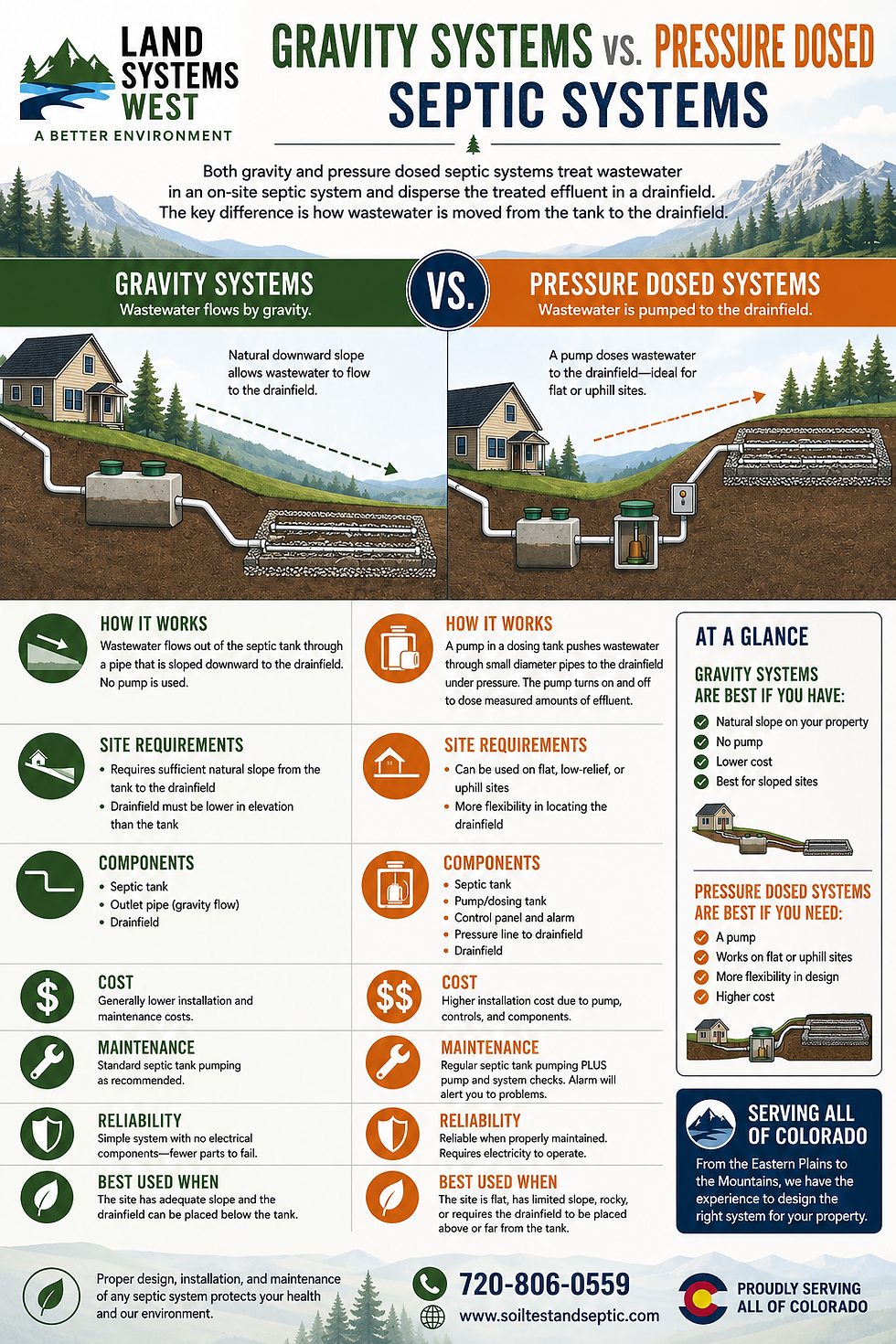
9. Gravity-Fed vs. Pressure-Dosed Septic Systems
Both system types can be appropriate when properly designed and approved for the property.
Gravity-fed septic systems
Gravity systems use elevation differences to move wastewater through system components.
They can be a practical option when the property has suitable elevations, soil conditions, and layout.
Pressure-dosed septic systems
Pressure-dosed systems use a pump and distribution network to deliver wastewater according to the approved design.
They may be appropriate where pressure distribution is required or where site conditions support a pressure-dosed configuration.
The right system depends on the soil evaluation, site layout, design flow, applicable regulations, and permitting requirements. Pressure dosing is not automatically superior to gravity distribution.
10. Colorado County Septic Permit Resources for 2027
Start with the official resources below to identify permitting information for your property.
Front Range County Septic & Environmental Health Links
Adams County: Visit the Adams County Health Department Septic Systems page for local OWTS regulations and permit information.
Arapahoe County: Access the Arapahoe County Public Health Septic Systems page for permits, guidelines, and transfer-of-title requirements.
Boulder County: Check the Boulder County SepticSmart page and OWTS Permits and Fees for local applications, forms, and policy rules.
Broomfield (City and County): Review the Broomfield Public Health and Environment Septic Systems page and department portal.
Douglas County: Search septic records and review guidelines via the Douglas County Septic System Records page or Douglas County Septic Resources.
El Paso County: Find permitting instructions, inspector lists, and rules on the El Paso County Public Health OWTS page.
Larimer County: Look up property records, schedules, and application guides on the Larimer County Septic Systems (OWTS) page.
Weld County: Find contacts, permit packets, and guidance on the Weld County Environmental Health Septic Systems page.
Statewide Resources
CDPHE: View statewide rules and county data links on the CDPHE On-site Wastewater Treatment Systems (OWTS) portal.
Adams County:
Arapahoe County:
Boulder County:
Broomfield (City & County):
Douglas County:
El Paso County:
Larimer County:
Weld County:
Colorado Department of Public Health & Environment (Statewide):
Chaffee County:
Clear Creek County:
Remaining Rocky Mountain & Western Slope Counties
For counties where a direct septic permitting page is not listed, contact the public health or environmental health department to identify the responsible agency and current application requirements.
Regulations, fees, and application procedures can change. Confirm the requirements that apply when you submit your 2027 application.

11. Frequently Asked Questions About Colorado Septic Systems in 2027
Can you build a house before getting septic approval?
NO. A building permit will not be issued first. You should establish septic feasibility and confirm the required permitting sequence before construction. Building approval does not automatically authorize a septic system.
What happens if a perc test fails?
Failed just means an unfavorable result requires further evaluation of the findings. Depending on the site, additional investigation, a different treatment area, or another approved design may be possible. We usually always have a work around.
How deep do septic test pits need to be?
The required depth is 8ft or until refusal. No if's, ands or buts.
Can you install a septic system in shallow bedrock?
Possibly, but bedrock depth and required separation distances can affect system feasibility and design. A site-specific evaluation is necessary. This usually requiresa sabd filter of 3ft and over excavation or a sand mound.

Can you replace a septic tank without a permit?
NO. Absolutley Not. Do not assume a replacement is exempt. Requirements depend on the scope of work and local rules. Confirm the permitting requirements before starting.
Can you add bedrooms to a home with an existing septic system?
Possibly, but additional bedrooms may affect design flow and system capacity. Check the approved system records and obtain any required review or approval before expanding the home. Yuo will need a use permit inspection and possibly a soil test if an expansion is needed.
How long does septic permitting take?
Processing times vary by agency, application completeness, site complexity, and required revisions. Contact the responsible permitting agency for current estimates.
Douglas County is the best at approval in the same day sometimes. El Paso county is the worst at around 9 months of very frustrating communicartions with government.
Can property owners perform their own perc tests?
NO. You need a state certified soil scientist. The applicable regulations establish qualifications for certain soil evaluations and percolation tests. Confirm who may perform and document the required work before conducting testing yourself.
Is a septic system guaranteed if the land is advertised as buildable?
No. A real estate listing or general building designation is not a guarantee that a particular septic design will be approved. Investigate soil conditions, setbacks, access, and permitting requirements.
When should you schedule septic soil testing?
As early as practical and before any lot or building size planning takes place during property due diligence or building planning. Early evaluation helps identify constraints before the home, driveway, well, and other improvements are finalized.
12. Why Choose Land Systems West for Colorado Septic and Land Services?
Land Systems West LLC works with Colorado property owners and builders on septic-related planning and land development needs, including soil testing, site evaluation coordination, excavation, trenching, and land preparation.
Every property has different requirements. Our goal is to help clients understand site conditions, coordinate the work needed for their project, and plan the next steps with better information.
Whether you are building a home in Douglas County, evaluating acreage in Elbert County, or planning a mountain property near Leadville, start with the soil and the regulations.
100% of our winter work is fixing other peoples installs when we are not plowing snow.
We are a licensed General Contractor as well and do full home builds, so if you have any questions we are familiar with the entire buidling process for residential and commercial.
Contact Land Systems West
Land Systems West LLC
Phone: 720-806-0559
Website: www.soiltestandseptic.com
Service area: Colorado
Contact Land Systems West to discuss your septic soil testing, perc testing, excavation, and land development needs.
Planning a Colorado build in 2027? Start with the soil. Understand the permitting requirements. Make informed decisions before construction begins.
This article is intended for general educational purposes and does not replace a site-specific soil evaluation, professional engineering advice, or approval from the responsible permitting agency. Verify the current Colorado regulations and local requirements applicable to your project in 2027 or give us a call for any Colorado septic pricing questions.

Comments